



The best time to take CoQ10 is with a meal that contains fat. Morning or night makes little difference. What matters is the fat, because CoQ10 is fat soluble and absorbs far better with food than on an empty stomach.
Last updated: 28 August 2026
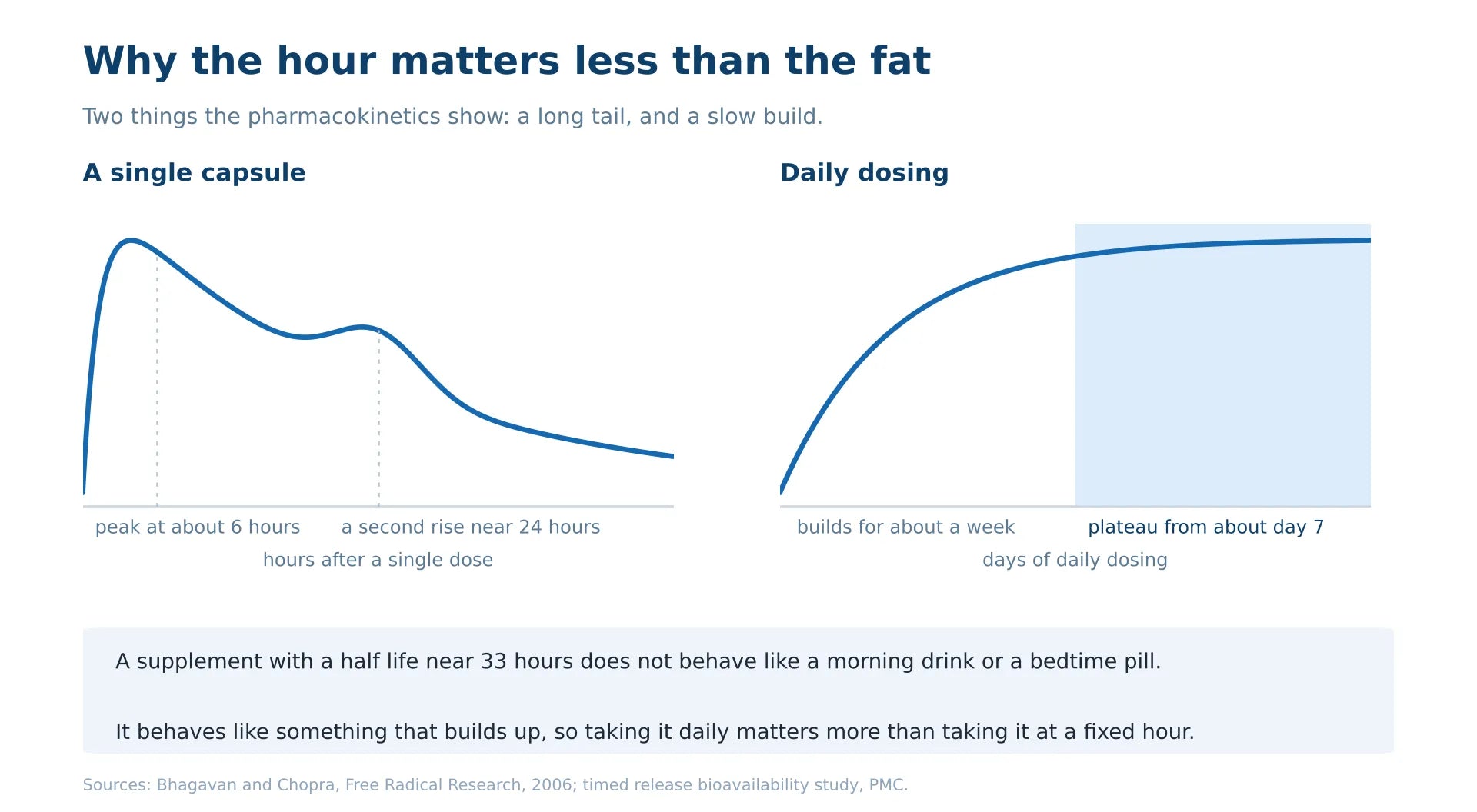
CoQ10 stays in the blood far longer than most people assume. Its elimination half-life is roughly 33 hours, and peak plasma levels arrive about six hours after a capsule is swallowed [1].
Those two numbers change the timing question. A supplement that lingers for well over a day is not really behaving like a morning drink or a bedtime pill. It is behaving like something that builds up.
Research tracking daily supplementation found plasma CoQ10 rose steadily for about a week, then levelled off between day 7 and day 14 and stayed fairly constant after that [2].
So the clock hour matters less than most timing guides suggest. What the evidence actually points to is different: absorption depends heavily on what is eaten alongside it.
The information on this page is for educational purposes only. It is not intended to diagnose, treat, cure, or prevent any disease. Consult a healthcare professional before making changes to your supplement routine. Statements on this page have not been evaluated by the Food Safety and Standards Authority of India (FSSAI).
What the Research Says About the Best Time to Take CoQ10
CoQ10 is fat soluble and has a large molecular weight. Both properties make intestinal absorption slow and limited [1].
Fat changes that. Bile salt micelles released into the small intestine after a fatty meal help carry poorly soluble compounds across the gut wall, which is why CoQ10 taken after a meal containing fat is absorbed better than CoQ10 taken alone [1].
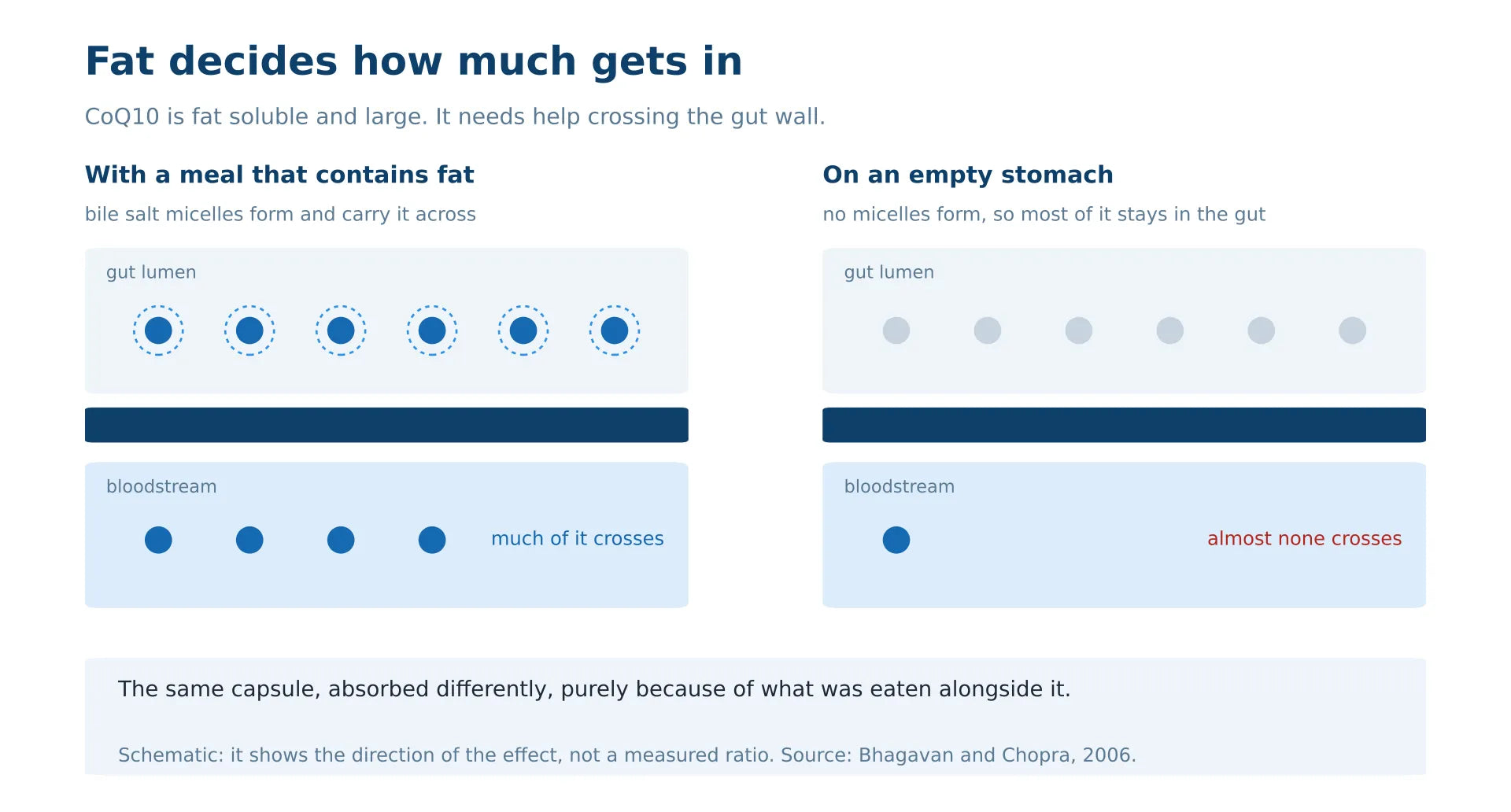
This is the part almost every ranking page gets right. It is also the part that matters most.
The timing advice that follows from it is simple. Pair the capsule with a meal that contains some fat. Whether that meal happens at 8am or 2pm is a smaller variable than whether the fat is there at all.
A second detail in the pharmacokinetics is worth knowing. Plasma CoQ10 rises again around 24 hours after a dose, likely reflecting enterohepatic recycling and redistribution by the liver into circulation [1].
That secondary peak is another sign this is a compound with a long tail, not a fast-acting one.
Why Taking CoQ10 With Food Matters More Than the Hour
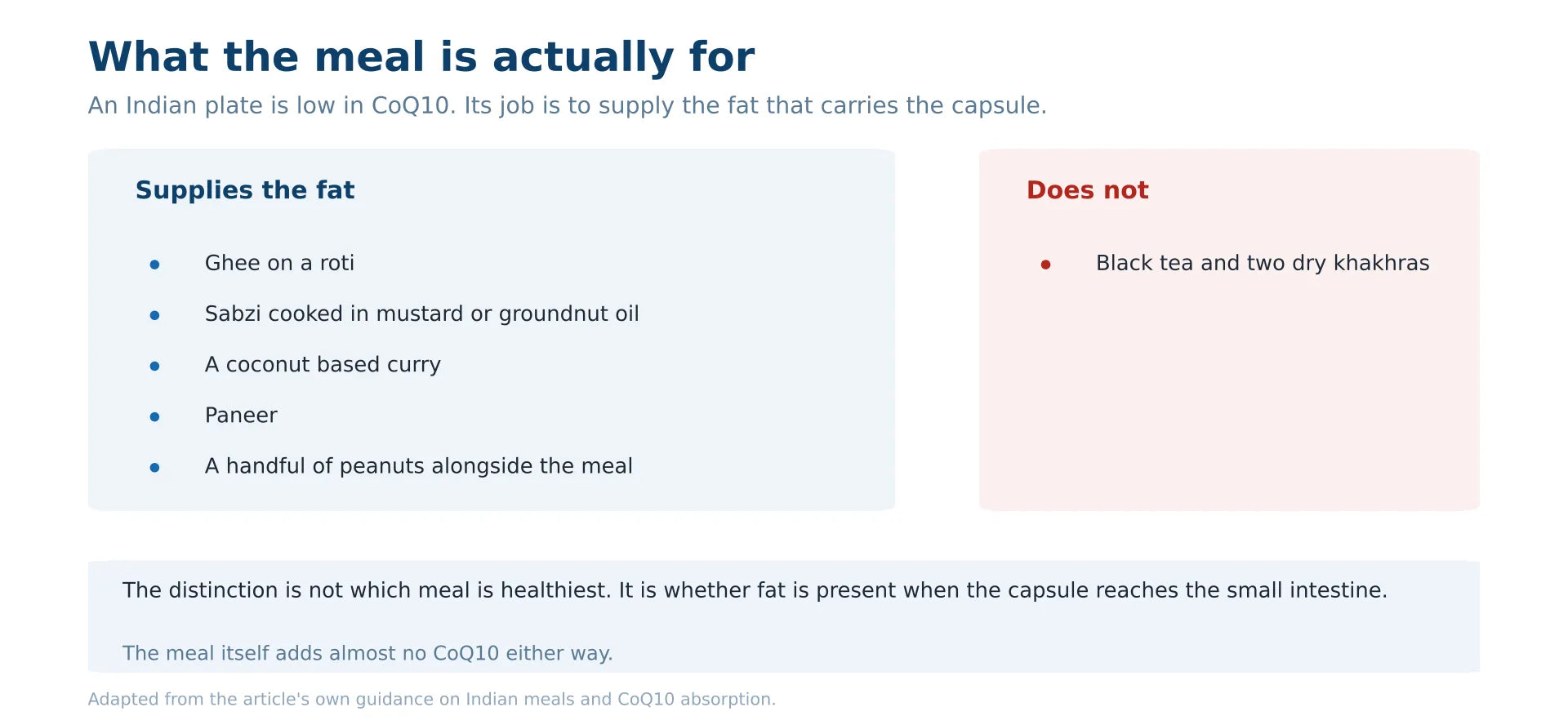
An Indian vegetarian plate built on dal, rice, roti and sabzi is generally low in CoQ10. The richest dietary sources are organ meats and oily fish such as sardines, while plant foods including spinach, broccoli, soybeans and peanuts contain considerably smaller amounts.
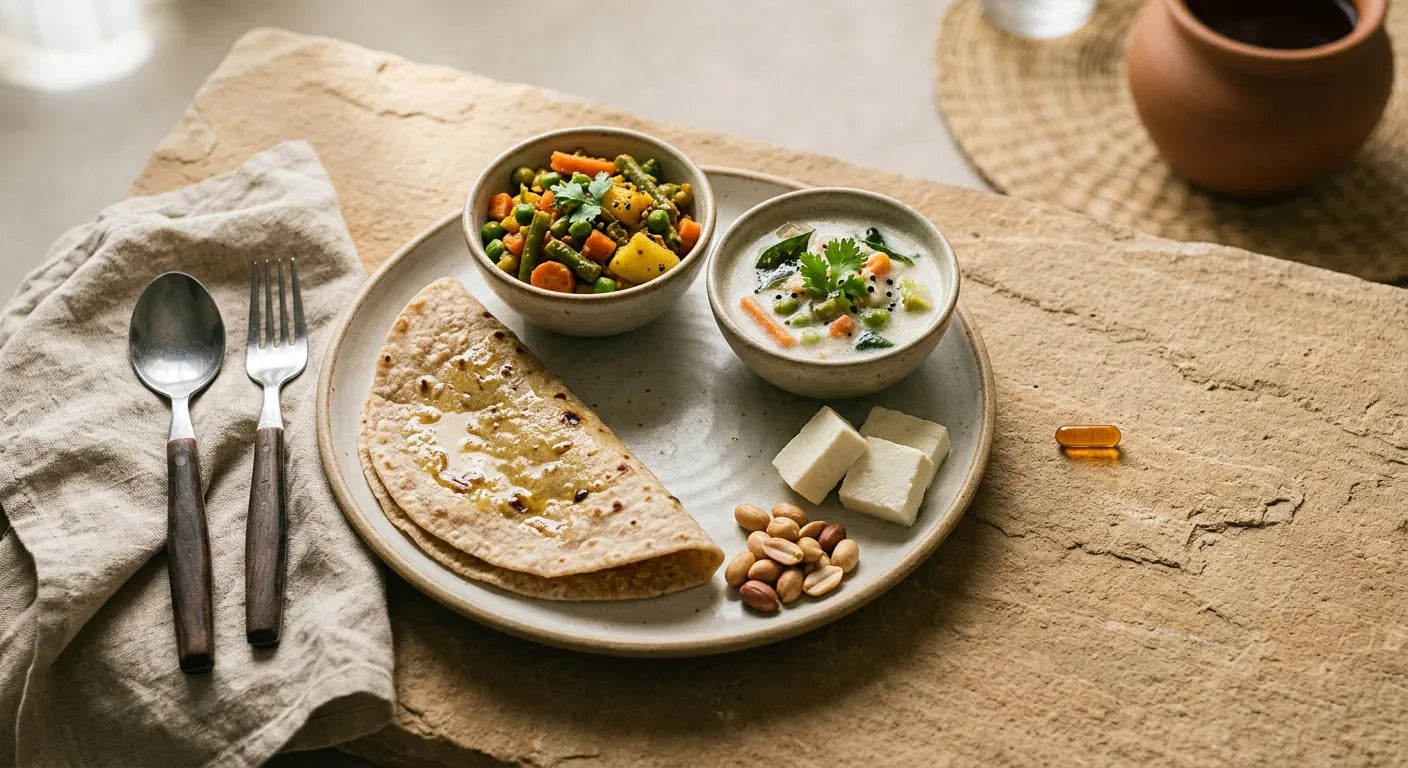
That gap is relevant to timing for a practical reason. If the meal itself contributes very little CoQ10, the meal's job is not to add more. Its job is to supply the fat that helps a supplement get absorbed.
Indian cooking usually supplies that fat without any special effort. Ghee on a roti, a sabzi cooked in mustard or groundnut oil, a coconut-based curry, paneer, or a handful of peanuts alongside the meal all provide it.
A cup of black tea and two dry khakhras does not.
The distinction is not about which meal is healthiest. It is about whether fat is present at the moment the capsule reaches the small intestine.
Should CoQ10 Be Taken at Night or in the Morning?
Most timing guides land on morning or early afternoon. The reasoning offered is usually that CoQ10 supports mitochondrial energy production and may feel stimulating for some people close to bedtime.
Here the evidence thins out considerably. Reports of sleep disturbance from evening CoQ10 come largely from anecdotal accounts rather than controlled sleep studies, and the published trial literature has not established that CoQ10 disrupts sleep.
That does not make the caution useless. It makes it a personal variable rather than a rule.
Someone who takes CoQ10 with dinner and sleeps normally has no particular reason to move it. Someone who notices restlessness after an evening dose has a reasonable case for shifting it earlier.
The stronger argument for a morning or midday dose is duller than the energy explanation. Breakfast and lunch are simply the meals most people are most consistent about, and consistency is what drives the plateau described earlier [2].
Readers dealing with genuine evening restlessness are usually looking at a sleep issue rather than a CoQ10 issue, and The Oak Age has covered what the evidence supports for melatonin and for L-theanine and daytime anxiety separately.
How Split Dosing Affects CoQ10 Absorption
Because absorption from a single dose is limited, larger amounts are not absorbed proportionally. Beyond a point, increasing the amount in one capsule yields progressively less additional plasma CoQ10 [1].
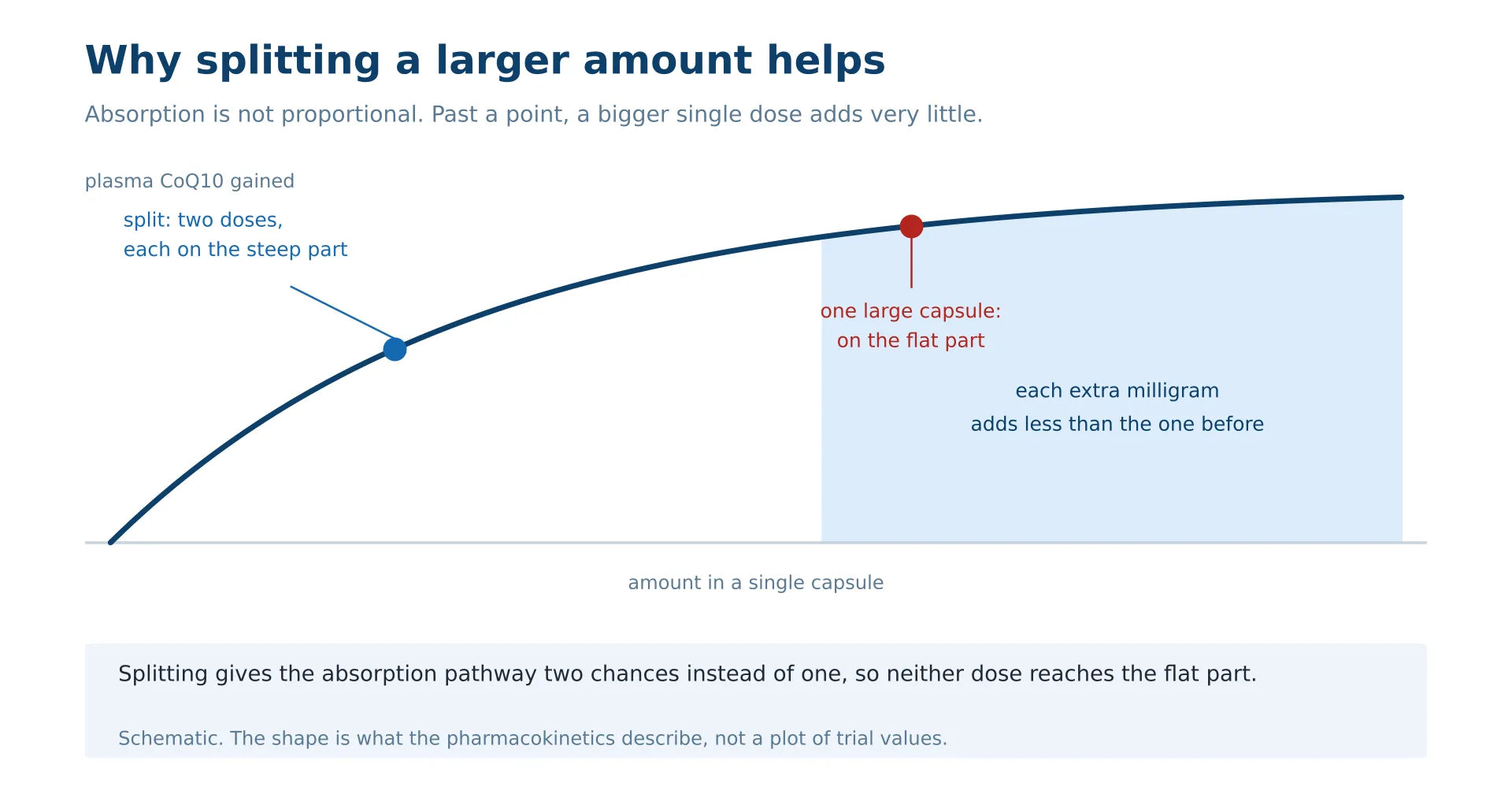
Beyond the point where a single dose stops adding uptake, splitting a large daily amount across two meals gives the absorption pathway two chances rather than one [1].
The practical implication concerns larger daily amounts rather than smaller ones. A modest amount taken with one fatty meal is unlikely to saturate anything. Larger amounts spread across two meals give the absorption pathway two separate opportunities.
Formulation matters here too. Solubilised and emulsified preparations are absorbed better than dry powder pressed into a plain capsule [1], which is the reasoning behind delivery-enhanced formats such as the CavaQ10 formulation The Oak Age uses.
Anyone taking a specific amount for a specific reason should confirm the arrangement with their doctor rather than adjusting it independently.
CoQ10 Timing for People Taking Statins
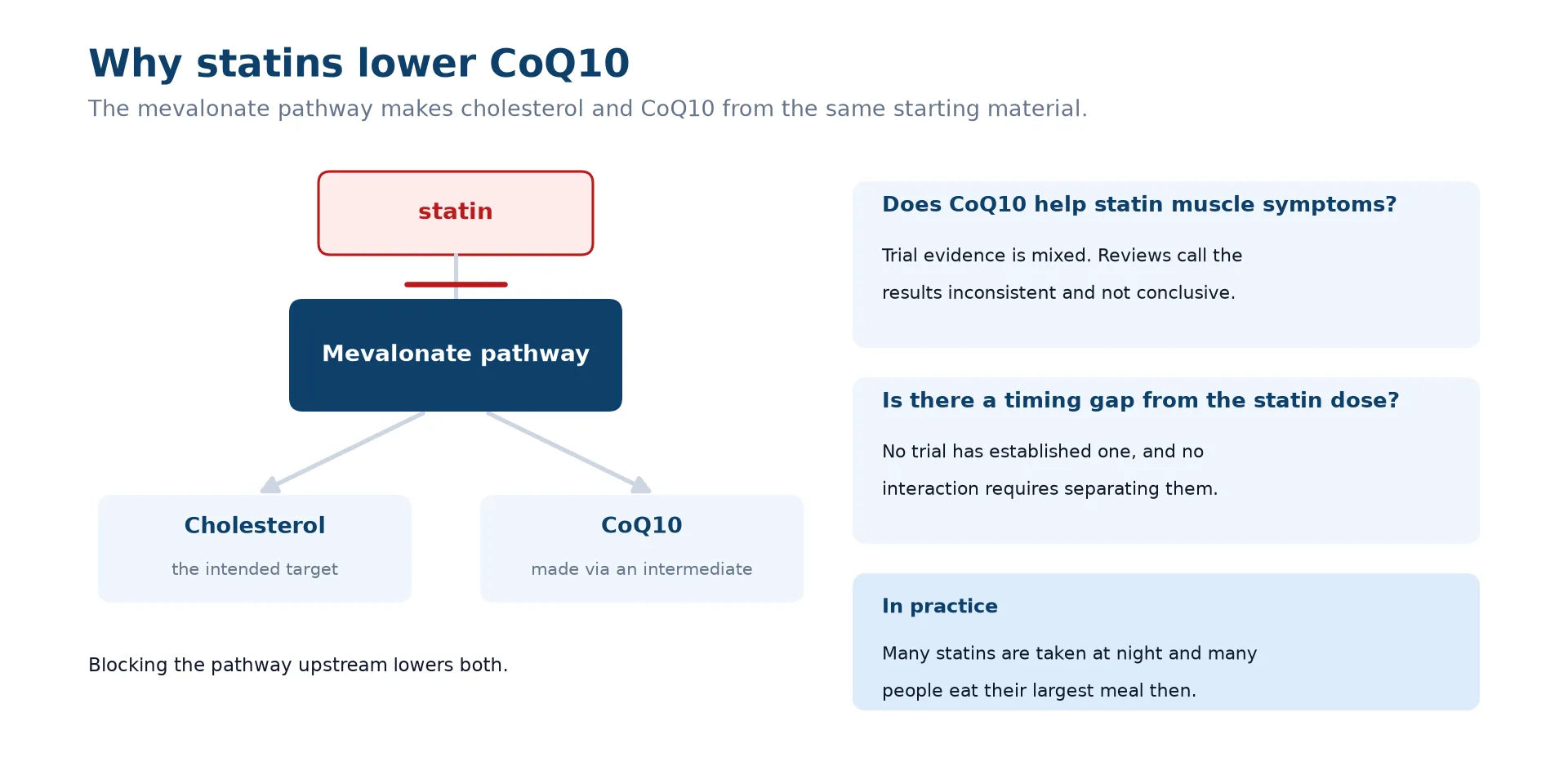
Statins act on the mevalonate pathway. That pathway produces cholesterol, and it also produces an intermediate the body uses to make CoQ10, which is why statin therapy is associated with lower circulating CoQ10 levels [3].
This is the most common reason people start looking into CoQ10 timing at all. It is worth separating two questions that often get merged.
The first is whether CoQ10 supplementation helps with statin-associated muscle symptoms. Evidence from randomised trials here is genuinely mixed, and reviews of the trial literature have described the results as inconsistent and not yet conclusive.
The second question is about timing, and the honest answer is that no trial has established an optimal gap between a statin dose and a CoQ10 dose. There is no established interaction requiring separation.
Since many statins are taken in the evening and many people eat their largest meal at night, taking both together is often simply convenient. That convenience is not a clinical recommendation, and anyone on a statin should raise the question with the doctor managing their prescription.
CoQ10 and statins, the two questions separated
| Question | What the evidence shows | What to do |
|---|---|---|
| Does CoQ10 help statin associated muscle symptoms? | Randomised trial evidence is genuinely mixed, and reviews describe the results as inconsistent and not yet conclusive | Ask the prescriber before starting or stopping anything |
| Is there a timing gap between the statin and the CoQ10? | No trial has established an optimal gap, and no established interaction requires separation | No adjustment needed on timing grounds |
| Why do statins lower CoQ10 at all? | The mevalonate pathway makes cholesterol and CoQ10 from the same starting material, so blocking it upstream lowers both | A reason to ask, not a reason to self prescribe |
| Is taking both together a recommendation? | No. It is convenience, since many statins are taken at night and many people eat their largest meal then | Raise it with the doctor managing the prescription |
The mechanism connecting statins and CoQ10 is covered in more depth in The Oak Age guide on why the heart needs CoQ10.
Does the Form of CoQ10 Change the Timing Advice?
CoQ10 supplements are sold as ubiquinone, the oxidised form, and ubiquinol, the reduced form. Ubiquinol is frequently marketed as substantially better absorbed.
The trial evidence is less settled than the marketing suggests. Some randomised crossover studies have found higher plasma CoQ10 after ubiquinol than after an equivalent amount of ubiquinone, while at least one crossover study in adults aged 65 to 74 found no statistically significant difference between the forms.
None of this changes the timing guidance. Both forms are fat soluble, and both are absorbed better with a meal containing fat.
Timing is the same for ubiquinol. Because both forms are fat soluble, take ubiquinol with a meal containing fat. No special hour is required.
Ubiquinone versus ubiquinol
| Question | What the evidence shows | Effect on timing |
|---|---|---|
| Which form absorbs better? | Contested. Some randomised crossover studies found higher plasma CoQ10 after ubiquinol than after an equivalent amount of ubiquinone. At least one crossover study in adults aged 65 to 74 found no statistically significant difference | None |
| Are both forms fat soluble? | Yes | Both need a meal containing fat |
| Does ubiquinol require a special hour? | No | None |
| Where does the form question belong? | A separate buying decision | Not a timing question at all |
Choosing between ubiquinone and ubiquinol is its own topic, and our guide to the best CoQ10 supplement for heart health in India walks through the forms.
A Practical CoQ10 Timing Routine
The evidence supports a fairly short set of principles.
Take it with a meal that contains fat, because that is the single largest lever on absorption [1].
Take it at whichever meal is easiest to remember every day, because plasma levels plateau only after about a week of consistent intake [2].
Split larger daily amounts across two meals, since a single large dose is absorbed inefficiently [1].
Expect the effect to build gradually rather than arrive the first evening.
If an evening dose seems to disturb sleep, move it earlier. If it does not, there is no strong evidence requiring a change.
Which meal should you pair CoQ10 with?
| If you... | Best choice | Why |
|---|---|---|
| Want the simplest habit | With breakfast | Most consistent meal of the day, and usually contains some fat |
| Feel alert after a dose | Take it before about 3pm | Avoids possible bedtime restlessness |
| Sleep fine and take statins at night | With dinner | Convenient, and no interaction requires separating them |
| Take a larger daily amount | Split across two fatty meals | A single large dose absorbs less efficiently |
What the evidence supports, and what it does not
| Claim | Evidence grade | What it means for you |
|---|---|---|
| Fat improves absorption | Well established. Bile salt micelles are needed to carry a poorly soluble compound across the gut wall | Take it with a meal that contains fat |
| Half life of roughly 33 hours | Established pharmacokinetics | The clock hour matters far less than most guides suggest |
| Levels plateau by day 7 to day 14 | Shown in tracking of daily supplementation | Take it daily and consistently, rather than perfectly on time |
| Absorption is not proportional | Established. Past a point, a larger single dose adds little | Split larger daily amounts across two meals |
| Solubilised or emulsified forms absorb better | Established | Delivery enhanced formats have a real basis |
| CoQ10 disrupts sleep | Anecdotal reports only. No controlled sleep study has established it | A personal variable, not a rule. Shift earlier only if you notice restlessness |
| Ubiquinol absorbs better than ubiquinone | Contested. Some crossover studies found a difference, at least one found none | Do not pay a premium on absorption grounds alone |
| CoQ10 helps statin associated muscle symptoms | Mixed. Reviews call the trials inconsistent and not conclusive | Ask the prescriber. Treat it as unsettled |
For readers wanting the broader picture on how mitochondrial energy production changes with age, The Oak Age guide on low energy after 40 covers the underlying biology, and the heart health guide for Indians sets CoQ10 in the context of cardiovascular risk. Those weighing CoQ10 against other options will find the guide to supplements and nutraceuticals for Indians useful, and readers focused on cellular ageing more broadly can read about NAD+ decline and the NMN with resveratrol formulation built around it.
Sources
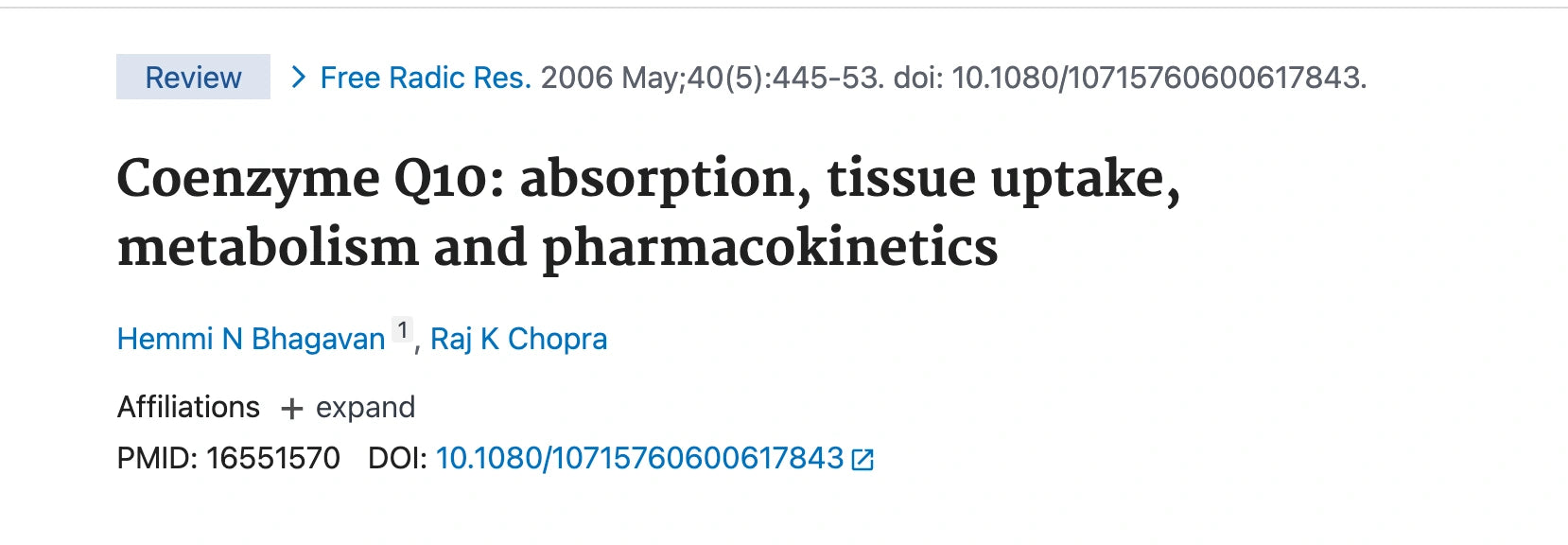
1. Bhagavan, Hemmi N., and Raj K. Chopra. "Coenzyme Q10: Absorption, Tissue Uptake, Metabolism and Pharmacokinetics." Free Radical Research, vol. 40, no. 5, May 2006, pp. 445-53. PubMed, https://pubmed.ncbi.nlm.nih.gov/16551570/.
2. "Bioavailability and Sustained Plasma Concentrations of CoQ10 in Healthy Volunteers by a Novel Oral Timed-Release Preparation." PMC, National Library of Medicine, https://pmc.ncbi.nlm.nih.gov/articles/PMC6471387/.
3. Keenaghan, Michael. "Coenzyme Q10." StatPearls, StatPearls Publishing, 30 Jan. 2024. NCBI Bookshelf, https://www.ncbi.nlm.nih.gov/books/NBK531491/.
The information on this page is for educational purposes only. It is not intended to diagnose, treat, cure, or prevent any disease. Consult a healthcare professional before making changes to your supplement routine. Statements on this page have not been evaluated by the Food Safety and Standards Authority of India (FSSAI).

