



Milk thistle has been used as a liver remedy since Roman times. It is also the ingredient with one of the widest gaps between what supplement labels promise and what controlled trials have found.
That gap is worth understanding before spending money on it.
The information on this page is for educational purposes only. It is not medical advice. Speak with a doctor before starting any supplement, especially if there is an existing liver condition or ongoing medication.
What Silymarin Is, and Why It Is Not the Same as Milk Thistle
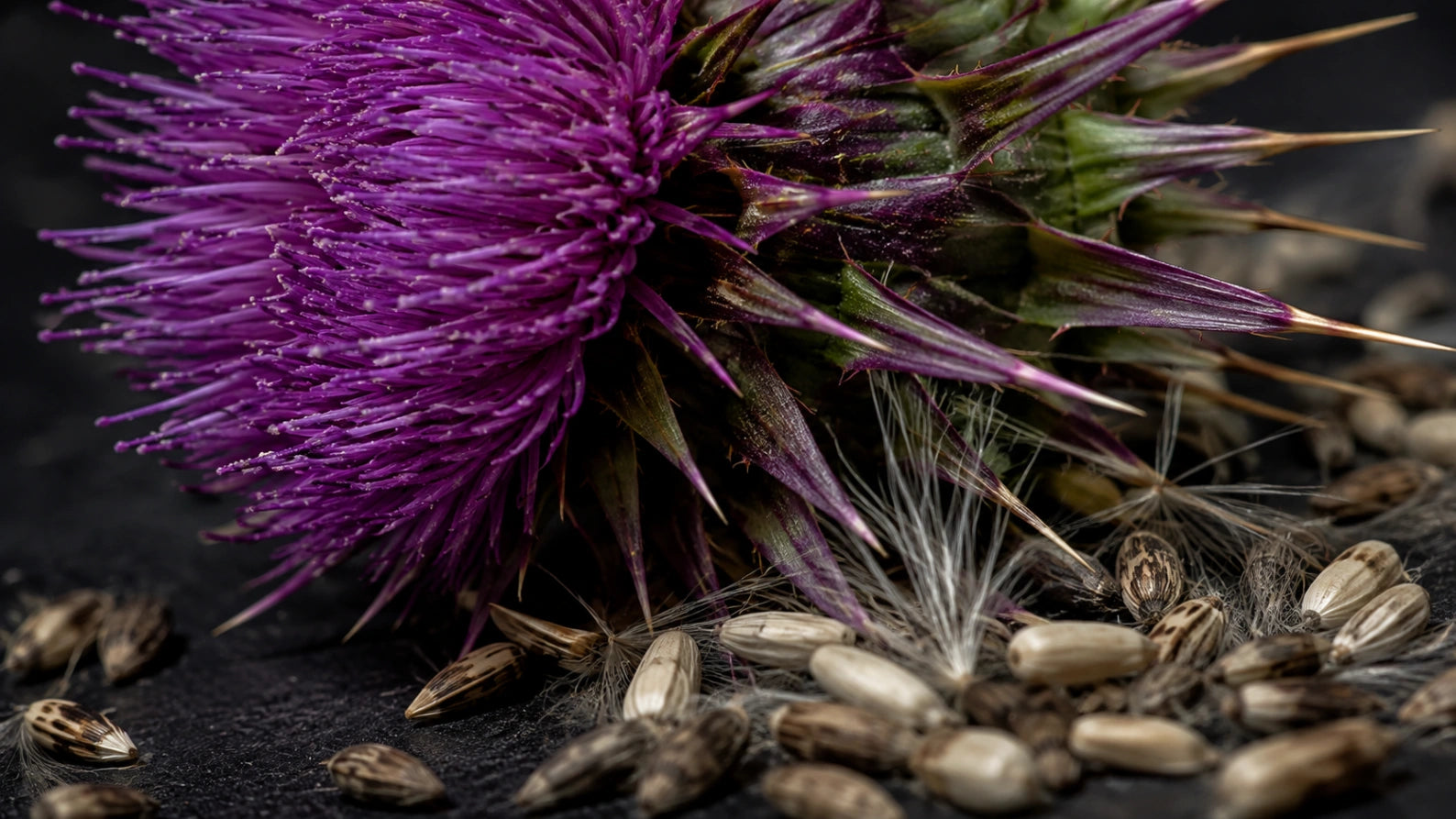
Milk thistle is the plant. Silymarin is what gets extracted from its seeds.
Silymarin is not one compound. It is a mixture of related flavonolignans, mainly silybin (also called silibinin), silychristin and silydianin [1]. Silybin is generally considered the most biologically active of the group.
This distinction matters commercially. A capsule labelled "milk thistle 1000 mg" may describe the raw seed powder, not standardised silymarin. Most clinical research uses extracts standardised to a stated silymarin percentage, so the two numbers are not comparable.
Standardised extracts sold as capsules typically contain 250 to 750 mg of ethanol-extracted silymarin, usually taken across two to three doses in the day [1].
How Silymarin Works in the Liver
The mechanism is well characterised in laboratory settings, and it is the reason the ingredient has held research interest for decades.
In cell culture and animal models, silymarin acts as an antioxidant, an anti-inflammatory, and an antifibrotic agent [1]. It scavenges free radicals and limits lipid peroxidation, the process by which oxidative stress damages cell membranes.
There is also a blocking effect at the cell surface. In animal studies, silymarin prevented or reduced acute liver injury caused by several toxins, including paracetamol and the death cap mushroom Amanita phalloides [1].
That last finding produced the one silymarin application with genuine clinical acceptance. Intravenous preparations of purified silybinin are approved in Europe for Amanita phalloides poisoning [1].
That treatment is an injected, purified, single-compound drug given for acute poisoning in a hospital. It is a different product from an oral capsule taken daily, and the evidence for one does not transfer to the other.
What Happened When Silymarin Was Tested in Fatty Liver Disease
Here the evidence splits in two, and both halves are worth reading.
The pooled data looks encouraging. A 2024 systematic review and meta-analysis pooled 26 randomised controlled trials covering 2,375 patients with non-alcoholic fatty liver disease. Silymarin was associated with reduced ALT and AST, the two liver enzymes used to gauge liver stress, along with lower total cholesterol, triglycerides and LDL cholesterol, and higher HDL [2].
The same analysis reported improved hepatic steatosis on liver histology, with an odds ratio of 3.25 [2]. Histology means an actual tissue change, not just a blood marker, which is a higher bar.
The best-controlled single trial did not. The SyNCH study, funded by the US National Center for Complementary and Integrative Health, gave 78 adults with non-alcoholic steatohepatitis either 420 mg silymarin, 700 mg silymarin, or placebo, three times daily, for 48 weeks. There were no differences in ALT, AST, or liver histology between the three groups [3].
Forty-eight weeks is a long trial. Those were high doses. And it still found nothing.
So which reading is correct? Both describe real data. The pooled analysis draws on many smaller and shorter trials of varying quality, several from regions where trial methodology and reporting standards differ. The SyNCH trial is a single, larger, well-funded, double-blind study designed specifically to be hard to fool.
The honest summary is the one the NIH's own review body reached: results across liver disease trials have been conflicting or too limited to support firm conclusions [4].
The Hepatitis C Result Nobody Advertises
Silymarin was tested seriously in chronic hepatitis C, and the answer was clear.
A randomised controlled trial published in JAMA gave 154 patients with chronic hepatitis C two different silymarin doses or placebo for six months. There was no effect on ALT levels or hepatitis C viral load [5].
A Cochrane systematic review reached a similar conclusion for alcohol-related liver disease and hepatitis B and C: no significant effect on mortality [1].
There is a real curiosity buried in this. Intravenous silibinin given daily for a week produced rapid, dose-dependent falls in hepatitis C viral load in patients who had failed standard therapy [1]. The compound does something. It just does not appear to do it when swallowed as a capsule at ordinary doses, which points to absorption as the limiting factor rather than the molecule itself.
The Supplement Quality Problem That May Explain the Mixed Results
This is the part of the silymarin story most product pages skip, and it may be the most important part.
Researchers analysed 26 commercial milk thistle supplements bought from the US and Czech markets. They found large differences in silymarin content between products, often contradicting the manufacturer's stated label, and substantial variation between different batches of the same product [6].
They also found contamination. Across the preparations tested, the analysis detected mycotoxins, several pesticides, and microbiological contamination [6].
The paper's own conclusion is that this poor quality may account for the unsatisfactory and non-reproducible clinical outcomes reported in the literature [6]. NCCIH cites the same concern in its consumer fact sheet [4].
Read that carefully. It means some of the trials showing no benefit may have been testing capsules that did not contain what the label claimed.
It also means the practical question for a buyer is not only "does silymarin work" but "does this particular bottle contain standardised silymarin in the stated amount." Those are separate problems, and the second one is checkable.
Why Silymarin and Liver Health Matter More in India
Fatty liver is not a fringe concern here.
A systematic review and meta-analysis estimated the pooled prevalence of non-alcoholic fatty liver disease among Indian adults at 38.6% [7]. Roughly one in three adults. In higher-risk subgroups, the same analysis estimated 52.8% [7].
Indians also tend to develop metabolic disease at lower body weight than Western reference populations, which means a normal-looking BMI is not reassurance on its own. Indian population studies found diabetes, central obesity and insulin resistance each linked to fatty liver [7].
A large share of people searching for liver supplements in India are therefore searching with a real, prevalent condition in the background, not a vague wellness goal. That raises the stakes on getting the evidence right rather than accepting the marketing version.
Fatty liver also rarely arrives alone. It travels with the same metabolic picture covered in why Indians are prone to insulin resistance, and readers working through the wider picture may find the blood sugar management guide for Indians more useful than any single ingredient page.
What to Check Before Buying a Silymarin Supplement
Given that product quality is a documented weak point, these are the things worth verifying on a label.
Standardisation percentage. Look for an extract standardised to a stated silymarin content, not just a raw milk thistle seed weight. Without a percentage, the actual silymarin amount is unknown.
Batch testing. Given the documented contamination findings, third-party or batch-level testing for heavy metals, pesticides and microbial load is a reasonable thing to expect a brand to publish. The same purity questions worth asking of any berberine supplement sold in India apply here with more force, because the contamination evidence for milk thistle is specific and published.
What it is paired with. Silymarin is frequently combined with other actives. That is not automatically a problem, but it does mean checking that the silymarin dose has not been reduced to a token amount to make room on the label.
Realistic claims. Any product page claiming silymarin detoxifies, repairs, or cures the liver is describing something the trial evidence does not support. Cautious language is a better sign than confident language here.
For readers already tracking metabolic markers, silymarin often appears alongside berberine in Indian formulations. The Oak Age pairs the two in its Blood Sugar Support with Himalayan Berberine and Milk Thistle and its LDL Cholesterol Support formulation, where the berberine is doing the metabolic work described in the trial literature and the silymarin is included for liver support.
Understanding the ingredient properly is the point. Whether it belongs in any individual routine is a conversation for a doctor who can see the person's liver function tests, and how long to continue it is covered separately in how long you should take supplements for.
What Silymarin Appears Genuinely Good At
Two things stand out from the evidence, and neither is the thing usually advertised.
The first is safety. Despite very wide use in people both with and without liver disease, milk thistle has not been implicated in causing raised liver enzymes or clinically apparent liver injury [1]. The NIH's LiverTox database assigns it a likelihood score of E, its lowest category, meaning an unlikely cause of liver injury [1]. Reported side effects are mostly mild digestive symptoms such as bloating, nausea and gas [4].
The second is blood sugar. A small number of human studies suggest milk thistle extracts may help control blood sugar in people with type 2 diabetes, though most of that research was conducted in Middle Eastern countries and it is unclear whether results would hold elsewhere [4]. The 2024 NAFLD meta-analysis also found reductions in fasting insulin and HOMA-IR, a measure of insulin resistance [2].
This is why silymarin tends to show up in metabolic formulations rather than standalone liver products. The berberine evidence for fatty liver and NAFLD is considerably stronger on that front, which is worth knowing when reading a combination label.
That is a more modest claim than "liver detox." It is also better supported.
Who Should Be Careful with Milk Thistle
Silymarin's safety record is good, but good is not universal.
People allergic to plants in the daisy family, including ragweed, chrysanthemum and marigold, may react to milk thistle [4]. Anyone taking prescription medication should check with a doctor first, since herb-drug interactions are possible [4]. Little is known about safety during pregnancy or breastfeeding [4].
Silymarin does affect cytochrome P450 enzymes and liver transporters in laboratory conditions, though there is limited evidence that this causes clinically significant interactions in practice [1]. Limited evidence is not the same as no risk, which is why the doctor conversation matters for anyone on regular medication.
References
1. National Institute of Diabetes and Digestive and Kidney Diseases. "Milk Thistle." LiverTox: Clinical and Research Information on Drug-Induced Liver Injury, 21 Jan. 2020, www.ncbi.nlm.nih.gov/books/NBK548817/.
2. Li, Shudi, et al. "Administration of Silymarin in NAFLD/NASH: A Systematic Review and Meta-Analysis." Annals of Hepatology, vol. 29, no. 2, 2024, p. 101174, pubmed.ncbi.nlm.nih.gov/38579127/.
3. Navarro, Victor J., et al. "Silymarin in Non-Cirrhotics with Non-Alcoholic Steatohepatitis: A Randomized, Double-Blind, Placebo Controlled Trial." PLoS ONE, vol. 14, no. 9, 2019, e0221683, pubmed.ncbi.nlm.nih.gov/31536511/.
4. National Center for Complementary and Integrative Health. "Milk Thistle: Usefulness and Safety." NCCIH, Feb. 2025, www.nccih.nih.gov/health/milk-thistle.
5. Fried, Michael W., et al. "Effect of Silymarin (Milk Thistle) on Liver Disease in Patients with Chronic Hepatitis C Unsuccessfully Treated with Interferon Therapy: A Randomized Controlled Trial." JAMA, vol. 308, no. 3, 2012, pp. 274-282, pubmed.ncbi.nlm.nih.gov/22797645/.
6. Fenclova, Marie, et al. "Poor Chemical and Microbiological Quality of the Commercial Milk Thistle-Based Dietary Supplements May Account for Their Reported Unsatisfactory and Non-Reproducible Clinical Outcomes." Scientific Reports, vol. 9, no. 1, 2019, p. 11118, pubmed.ncbi.nlm.nih.gov/31366891/.
7. Shalimar, et al. "Prevalence of Non-alcoholic Fatty Liver Disease in India: A Systematic Review and Meta-analysis." Journal of Clinical and Experimental Hepatology, 2022, pubmed.ncbi.nlm.nih.gov/35677499/.
The information on this page is for educational purposes only. It is not intended to diagnose, treat, cure, or prevent any disease. Consult a healthcare professional before making changes to your supplement routine. Statements on this page have not been evaluated by the Food Safety and Standards Authority of India (FSSAI).

